Leading Into the Mystery
The significant role of the priest in the Christian initiation of adults
Father Gerald Dennis Gill Comments Off on Leading Into the Mystery
The recently revised English translation of the Order of Christian Initiation of Adults for the dioceses in the United States, which went into mandatory use March 5, 2025, presents a tremendous opportunity for a more effective implementation of the order in a variety of ways. With the publication of revised translations of this and other ritual books, there is a risk of simply replacing one book for another without sufficient and renewed reflection on the content, structure and pastoral practice of the respective rites. The revised English translation of the order suggests a more profound study of its liturgical, theological and pastoral values. The ritual books belong to the whole Church, the clergy and the faithful. But the priest has an indispensable role in making full use of the rite for the substantial benefit of the faithful.
Since the Order of Christian Initiation of Adults was first introduced in the United States following the reforms prompted by the Second Vatican Council (1962-1965), it has been more or less received as a catechetical tool for the unbaptized adult. Its reception has been further blurred by its use even for those who are baptized. The ritual book is a liturgical book in much the same way the Roman Missal and the Lectionary for Mass are the liturgical books for the celebration of the Eucharist. Thus, the Order of Christian Initiation of Adults in its use eminently expresses the Church at worship: the priest and people assembled in the mystery of Christ on various occasions to assist the unbaptized on the way to baptism. Catechesis flows from the liturgical celebrations that mark the passage to baptism. Central, then, to this celebration of the liturgy are the necessary and respective roles of the ordained and the baptized for the benefit of those to be baptized.
One of the critical areas of rediscovery with the revised English translation of the Order of Christian Initiation of Adults is the significant role of the priest. He is more than a functionary for the rites. Rather, from beginning to end he is the one acting in the person of Christ, the head of his body, the Church, in this celebration of the liturgy. This essential liturgical role forms all those engaged in Christian initiation with an authentic understanding of the Church that will be manifested in their lifelong sacramental life as Christians. To dispense with the role of the priest in the Order of Christian Initiation of Adults is to fail to provide an authentic model of the Church and to allow the Church to do the work of initiation.
This article will look at the role of the priest in the order in general, and then more specifically in the four periods and three steps of Christian initiation. It may be helpful to have a copy of the ritual book in hand as you read.
The Priest’s Overarching Role
The ritual book Order of Christian Initiation of Adults is introduced with a universal document, “Christian Initiation: General Introduction” (CIGI), that outlines the Church’s overall liturgical, theological and pastoral understanding of Christian initiation for adults and children. The fundamental premise is that the preparation and instruction for baptism are the “highest concern for the People of God, that is the Church” (CIGI, No. 7). The Church properly understood means that all her members have a role, including the priest. In addition to outlining the duties and ministries of the lay faithful, especially as godparents and catechists (CIGI, Nos. 7-10), the priest celebrates the sacraments, assists the bishop in his duty regarding instruction for Christian initiation and assists catechists and godparents (CIGI, Nos. 13-14). These brief indications of the role of the priest in Christian initiation, which applies equally for the baptism of adults and children, is further developed and explained in the Order of Christian Initiation of Adults.
In fact, the introduction to the Order of Christian Initiation of Adults (OCIA) specifically addresses the role of the priest for the full sacramental initiation of an adult. It is for priests, in addition to the usual ministry that they exercise in any celebration of baptism, confirmation and the Eucharist, to attend to the pastoral and personal care of catechumens, taking special care of those who seem hesitant and troubled, and to provide for their catechesis with the help of deacons and catechists. They are to approve the choice of godparents and generously listen to them and help them. Finally, they are to see to the complete and appropriate use of the rites through the course of the Order of Christian Initiation (OCIA, No. 13)
This dimension of the role of the priest in the preparation of adults for the celebration of the sacraments of Christian initiation needs to be reassessed and recovered. All too often, in most parish settings, the priest is minimally present or even absent until the time of the celebration of the sacraments at the Easter Vigil.
The Four Periods of OCIA
The Order of Christian Initiation of Adults, restored to the life of the Church consequent to the Second Vatican Council, brings forward the tradition for Christian initiation to be marked with distinct periods and sacred rites (see Sacrosanctum Concilium, No. 64). The present-day periods are identified as the period of evangelization and precatechumenate, the period of the catechumenate, the period of purification and enlightenment, and the period of mystagogy. The role of the priest is described in each of these periods in differing yet essential ways.
The period of evangelization and precatechumenate has no beginning or end and takes place without any formal rites (OCIA, Nos. 36-40). It is during this period that the non-Christian first encounters the Lord and, with the help of the Holy Spirit, is prompted to conversion according to the truth of the Gospel. Priests are tasked, along with others, to offer “a suitable explanation of the Gospel” to foster the necessary evangelization and conversion as inquirers mature in their desire to seek baptism. The priest, with the local community, may be the one to receive the inquirer for this period, and in so doing immediately introduces the inquirer into the mystery of the Church, the priest and the faithful, who initiate others into Christ. Priests assist inquirers with appropriate prayers. Even the minor exorcisms and the blessings may be carried out by the priest for the spiritual benefit of the inquirer (OCIA, No. 40).
The period of the catechumenate is intended, for the catechumens, to be a lengthy period of instruction and formation in the faith, the Christian life, the celebration of liturgical rites and apostolic work (OCIA, Nos. 75-80). Always keeping in mind that it is the community of the Church that initiates someone into Christ and his Church, the same community is an integral part of this instruction and formation of catechumens as they prepare for the celebration of the Easter sacraments. The priest, among others, is an instructor and formator when, as a catechist, he guides catechumens “to a suitable knowledge of dogmas and precepts” for them to have “an intimate knowledge of the mystery of salvation.” Regular celebrations of the word of God, in addition to deepening the impact of catechetical instruction, pave the way for the catechumens to learn to worship during the Liturgy of the Word at Mass before they are dismissed (OCIA, No. 75.3, Nos. 81-89). When the priest presides at the celebrations of the Word, the sacramentality of the Church at worship becomes visible and is formative for the catechumens. This reality is emphasized in the Order of Christian Initiation of Adults for the period of the catechumenate:
From time to time during the year (i.e., the catechumenate), care should be taken at some of the celebrations of the catechumenate and the rites of passage, that the entire community come together, namely priests, deacons, catechists, sponsors and godparents, friends and relatives, who have a part to play in the initiation of catechumens. (OCIA, No. 80)

Detroit Catholic)
The minor exorcisms, the additional rites of passage throughout the catechumenate period — the blessings and anointing with the oil of catechumens — and the rite of sending catechumens for election all provide the priest with an opportunity to minister to the catechumens and the whole community in his unique role, in persona Christi, as head of the Body in a local and concrete way. This is one of the significant roles the priest will continue to have in the life of the catechumens as baptized members of the Church.
The period of purification and enlightenment begins with the election of the catechumens on the First Sunday of Lent and continues through Lent (OCIA, Nos. 135-140). The whole community of the Church, priest and people, derives from the Lenten liturgical celebrations and instruction the means to prepare to celebrate fully the paschal mystery during the sacred Easter Triduum. This preparation is accompanied by penitential acts, distinct for the elect from the baptized, to aid every member of the Church to turn away from sin and be faithful to the Gospel. This period, as with the others, depends on the communion within the Church, of priest and people together, to realize the power of conversion ignited by Lent for the unbaptized and the baptized.
For the elect, the required Sunday scrutinies, which “have the double purpose … to reveal what is weak, sick and sinful in the hearts of the elect so that it can be healed; and what is honorable, strong and holy, so that it can be strengthened” (OCIA, No. 141), most often take place during the celebration of the Eucharist. In addition to the priest’s duty, along with others, to prepare the elect for the scrutinies — especially to grasp the spiritual power of the exorcism that is part of it (OCIA, Nos. 154, 168, 175) — the priest is an icon of the mercy of the Lord. This image will perdure in the lives of the elect when, as baptized Christians, they will know the mercy of God through encounters with the priest in the Sacrament of Reconciliation.
The rites of handing on the creed and the Lord’s Prayer, although they can be anticipated (OCIA, Nos. 79, 104-105), are typically carried out along with the scrutinies during Lent (OCIA, Nos. 147-149). The Church entrusts these ancient texts of faith and prayer to enlighten the elect. Whenever both rites take place, the Order of Christian Initiation of Adults is clear that they do so “in the presence of the community of the faithful” (OCIA, Nos. 157, 178). These ancient texts will continue to be part of the life of the elect when they assemble for the Sunday Eucharist as baptized members of the Church. Thus, it makes sense that the priest is part of the handing on of the creed and the Lord’s Prayer, as he will lead them during the celebration of the Eucharist once the elect are baptized.
The rites of immediate preparation on Holy Saturday morning, which the Order of Christian Initiation of Adults addresses during the period of purification and enlightenment (OCIA, No. 140), gives the priest another significant occasion to accompany the elect. In addition to presiding over the various rites (OCIA, Nos. 185-205), there is the opportunity for him to exhort the elect to observe Holy Saturday in a recollected way, free from the usual activities, and to keep the paschal fast, as well as to once again explain the word of God in anticipation of the Easter sacraments.
The period of mystagogy is the period of the Church when the priest and the neophytes, along with all the baptized, reflect on the Gospel, celebrate the Eucharist and serve one another in an intentional way. This allows for a deepening in understanding the paschal mystery of Christ (OCIA, Nos. 244-251). The principal way, however, for the neophytes to grasp more fully the power of the paschal mystery at work in their lives and in the community of the Church is through the celebration of the sacraments, especially the Eucharist and reconciliation. With the sacraments, the word of God takes on new power within the believing Christian community. The priest, along with the godparents and the whole community, are to work together to foster the greatest possible encounter with the risen Lord for the neophytes (OCIA, No. 246). As the priest and the faithful were a sign of the Church in the very first period, the period of evangelization and precatechumenate, and throughout the Order of Christian Initiation of Adults, for the work of initiation, they continue to be this sign to the recently baptized as they begin to live as full members of the Church.
The Three Steps of OCIA
The three steps in the present-day Order of Christian Initiation of Adults are the rite of entrance into the catechumenate, the rite of election or enrollment of names, and the celebration of the sacraments of initiation. These liturgical rites necessarily include the priest for his unique sacramental role. However, more is to be considered in each of these rites than his presiding over the liturgical action.
The rite of entrance into the catechumenate may or may not be carried out in conjunction with the celebration of the Eucharist. If it is not, a deacon may preside over the rite. However, prior to the liturgical celebration and as preparation for the rite, inquirers ought to have in place the beginnings of a spiritual life, a preliminary grasp of Christian doctrine, an ongoing conversion to Christ and a sense of the Church. This sense is more complete when the priest, along with members of the baptized, prepares the inquirers for this rite: “It is the particular responsibility of pastors, with the help of sponsors, catechists and deacons, to discern the outward signs of their spiritual dispositions” (OCIA, No. 43). Finally, it is important that the celebration of the rite likewise manifest the Church with the presence of friends, relatives, catechists and the priest (OCIA, No. 45).
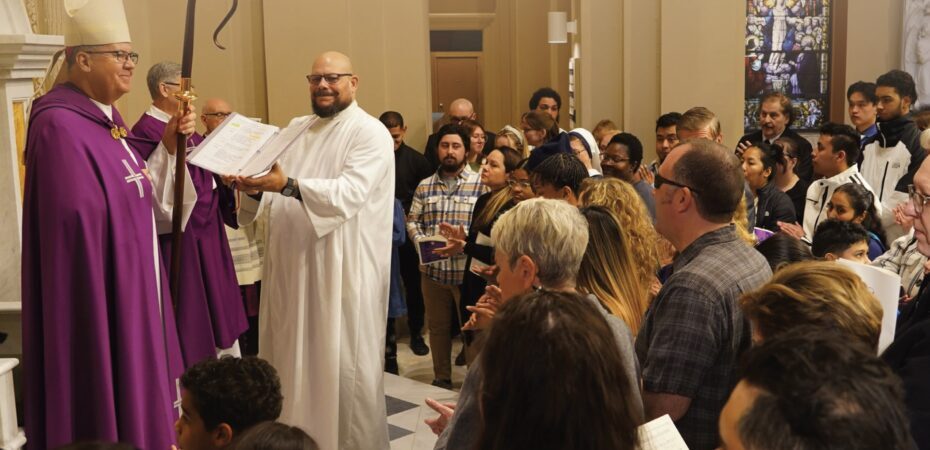
The rite of election or enrollment of names properly belongs to the bishop as the presiding celebrant, although he can delegate a priest or deacon to do so (OCIA, No. 121). It is the role of the whole community, priest and members of the faithful, in anticipation of the rite, to deliberate on the suitability of the catechumens as far as their conversion, knowledge of doctrine and sense of charity and, after a favorable judgment, to confirm this during the rite as they are presented for election (OCIA, Nos. 121-122). Thus, the Church — bishop, priests, deacons, catechists, godparents and the whole local community — embraces the elect and takes them with her to meet Christ (OCIA, No. 121). The priest is assigned a particular duty with regard to the godparents chosen by the catechumens for this rite. He is the one to give consent to the catechumens’ choice of godparents to ensure the role is properly understood and can be suitably carried out during the rite, for the celebration of the sacraments and as the neophytes live out their baptismal promises (OCIA, Nos. 11, 123).
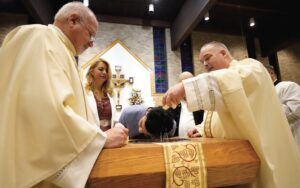
The celebration of the sacraments of initiation, the final and culminating step of Christian initiation, incorporates the elect into the People of God and offers them, now children of the Father in Christ and the Holy Spirit, a foretaste of the Kingdom of God through the Eucharistic sacrifice (OCIA, No. 206). The Church, priest and faithful, has brought the elect to this moment and surrounds them with the celebration of the sacraments. This is especially the case with the profession of faith that precedes their baptism. With their profession of faith, made in the presence of the bishop or priest celebrant and the community, they declare their intention to enter the new covenant with Christ that is shared with the whole Church and into which they will be baptized (OCIA, No. 211).
The priest has the additional role to prepare carefully for the celebration of the rites for each of these three steps, with a special focus on the conscious participation of the inquirers as they become catechumens, then the elect, and finally neophytes, along with the whole community, to allow for a vivid engagement of the mystery of the Church celebrating the saving mystery of Christ. A chief way for the priest to do this is with effective preaching of the word of God flowing from the texts of the rites along with the biblical texts.
Conclusion
As mentioned earlier in this article, the role of the priest in the Christian initiation of adults has all too often been frequently limited to the actual celebration of the sacraments at the Easter Vigil. When the Order of Christian Initiation of Adults is received as a liturgical ordo with its many rites, this becomes the first inroad for its use to be understood as worship primarily carried out by the whole Christ, the whole Church, priest and people, throughout all the periods and steps. Guided by the order itself, the priest’s role rises to a new level in pastoral practice. His presence and role are clearly identified and indicated, in conjunction with others, for each period and step.
The instruction and formation of adults for the sacraments of Christian initiation are authentically deepened and enriched as the work of the Church when the priest assumes his proper role. The revised English translation of the Order of Christian Initiation of Adults is a great opportunity to revise current pastoral practices to bring forward the irreplaceable role of the priest in Christian initiation.
FATHER GERALD DENNIS GILL is the rector of the Cathedral Basilica of Sts. Peter and Paul in Philadelphia, the director of the Office for Divine Worship for the Archdiocese of Philadelphia and adjunct faculty at Saint Charles Borromeo Seminary.