Hidden Hearts
The First Friday and First Saturday devotions should be better known
D.D. Emmons Comments Off on Hidden Hearts
Holy Mother Church offers dozens of wonderful devotions, demonstrations of faith beyond the Liturgy and Mass, such as the Rosary, Stations of the Cross, Eucharistic adoration, Chaplet of Divine Mercy, pilgrimages and more. Two devotions not as widely practiced as these are the First Friday devotion of reparation to the Sacred Heart, requested by Jesus, and the First Saturday devotion of reparation to the Immaculate Heart, requested by Mary. Through these devotions we are asked to make atonement for the insults the world has heaped on both Our Savior and the Blessed Mother.
Given the intent and fruits associated with these pious observances, it is not clear why they receive less attention. Perhaps the faithful are not fully aware of these practices. For example, how many of us know the 12 promises of Jesus through his Sacred Heart?
In 1956, Pope Pius XII, in his beautiful encyclical Haurietis Aquas (“On Devotion to the Sacred Heart”) said the Church has long spread devotion to the Sacred Heart, but adds, “In spite of this it is much to be regretted that, both in the past and in our own times, this most noble devotion does not find a place of honor and esteem among certain Christians and even occasionally among those who profess themselves moved by zeal for the Catholic religion and the attainment of holiness” (No. 8).
First Fridays and the Sacred Heart
In our parish is a statue of the Sacred Heart. The right arm of Jesus is at his side with the pierced palm of his hand facing out. His left hand, also pierced, is touching his heart almost as if he is about to hand it to us. Indeed, that is what he does: He gives us his heart — gives us his infinite love.
Christian devotion to the Sacred Heart, the eventual essence of First Fridays, had its beginning when the Roman soldier stuck his lance into the side of the crucified Jesus. “The foundation of this [Sacred Heart] devotion was laid upon Mount Calvary when the Divine Heart of the Redeemer, pierced by the lance, was opened as an invisible asylum of refuge for the faithful followers of Christ,” explains Father F.J. Shadler in his 1881 book, “The Beauties of the Catholic Church.” “The apostle John used the expression, ‘One of the soldiers opened his side,’ to indicate that the side of the Savior was opened for no other purpose than to afford free access to his heart. Viewed in this light, the devotion to the Sacred Heart is nothing new.”
At first the Sacred Heart was a personal or individual observance, but that changed over the centuries. St. John Eudes (1601-1680) was among the first Church figures to promote the Sacred Heart as a public devotion. He advanced his passion for both the Sacred Heart of Jesus and the Immaculate Heart of Mary into the liturgy.
Public adoration of the Sacred Heart became universal after Jesus appeared later in the 17th century to St. Margaret Mary Alacoque. According to the saint, Jesus visited her several times between 1673 and 1675. Our Savior told Margaret Mary, who was a nun at the Convent of the Visitation in Paray-le-Monial, France, that he was offended because mankind continued to treat him with ingratitude and irreverence. From his birth, many reviled him and all he professed; through the centuries he has been scorned, ridiculed and ignored, contrary to the fact that he loves us with an enduring love. Jesus requested St. Margaret Mary to honor the love flowing from his Sacred Heart by receiving holy Communion on the First Friday of every month and spending a Holy Hour seeking to make amends for the hateful way the world had long treated him. This request would grow into the First Friday devotion.
Later Jesus asked St. Margaret Mary to seek a Church-wide celebration, a day to annually acknowledge his Sacred Heart and make reparation for all the times the love he offers has been rejected. In 1856, Pope Pius IX assigned the Friday following Corpus Christi Sunday as the solemnity of the Most Sacred Heart of Jesus; today the entire month of June is dedicated to this devotion. First Friday devotions were permitted throughout the entire Church in 1889 by Pope Leo XIII. Ten years later, Pope Leo, through his encyclical Annum Sacrum (“Holy Year”), consecrated the world to the Heart of Jesus. The pope said that this consecration was the greatest act of his papacy.
The heart of Jesus is a symbol of the overflowing love he has for us; when we say we love someone with our whole heart, we mean we love that person with our whole being. And so it is with Jesus in his love for us. As Pope Francis wrote in Dilexit Nos (“He Loved Us”), “Yet, while the depiction of a heart afire may be an eloquent symbol of the burning love of Jesus Christ, it is important that this heart be not represented apart from him” (No. 54).
Carrying Out the First Friday Devotion
To carry out the Friday devotions, on the First Friday of nine consecutive months we receive holy Communion and seek forgiveness for our own sins and those of the world against the Sacred Heart, against Jesus. He came with love, suffered for our sins and the world repays him with denial — “we held him in no esteem” (Is 53:3).
Parishes differ in their First Friday celebrations: In addition to Mass, some offer a Holy Hour of adoration, pray the Litany of the Sacred Heart or pray the act of reparation to the Heart of Jesus. The intent is to focus on making restitution for sins against his Divine Heart, to alleviate his sorrow.
According to St. Margaret Mary, Jesus promised to all who participate in the nine First Friday devotions: all the graces necessary for their state in life, peace in their families, consolation in time of trouble, assured refuge in the heart of Jesus during life and especially at the hour of death, abundant blessings on all undertakings, and his infinite mercy. In addition, he promised that the tepid soul will become fervent, that fervent souls will attain great perfection, that homes where the image is exposed will be blessed, that priests will be able to touch the most hardened hearts, that the names of those who promote this devotion will be etched in his heart, and that participants will receive the grace of final repentance, with his heart their assured refuge at their last hour.
Many Catholic families have their homes and families consecrated to the Sacred Heart. Ideally, a priest carries out this consecration in accordance with an established ritual.
First Saturdays and the Immaculate Heart
For centuries, the Church has dedicated every Saturday to the Blessed Mother in imitation of Sunday’s dedication to Jesus. St. Thomas Aquinas explained that “we keep Saturdays in veneration of the Blessed Virgin, in whom remained a firm faith on that Saturday while Christ was dead” (“Explanation of Ten Commandments”).
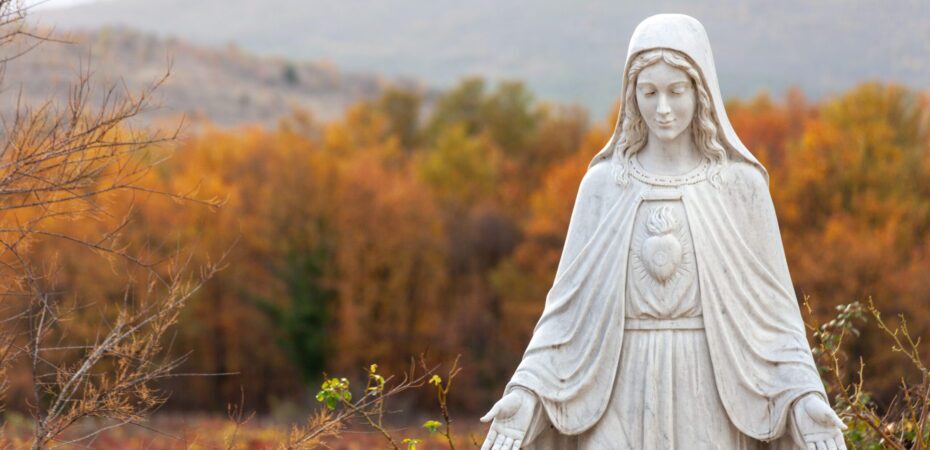
Devotion to the Immaculate Heart is traced to the New Testament. In St. Luke’s Gospel, Simeon tells Mary, “And you yourself a sword will pierce so that the thoughts of many hearts may be revealed” (2:35). Mary’s Immaculate Heart is often depicted as pierced by a sword. St. Luke also says that Mary kept “all these things” — the events of Jesus’ birth and childhood — “in her heart” (2:51). Under her heart beat the heart of Jesus.
The Middle Ages saw increased devotion to Mary and her Immaculate Heart. St. Gertrude the Great and St. Bridget of Sweden had a special affinity to the heart of the Blessed Mother. Sts. Bernard, Bonaventure and Bernardino of Siena all preached about the heart of Mary. By the 16th century, devotion to the Immaculate Heart was Church-wide.
During her appearance in 1917 to the children Lucia, Francisco and Jacinta at Fatima, Portugal, the Blessed Mother requested a universal devotion to her Immaculate Heart because of all the affronts made against her. She also asked for the conversion of Russia to her Immaculate Heart and “communion of reparation on First Saturdays.” Eight years later, the Blessed Mother again appeared to Lucia, then a postulant at a convent in Pontevedra, Spain. Mary asked Lucia to initiate a universal devotion to her Immaculate Heart because mankind was treating her in blasphemous ways, with indifference and coldness.
Carrying Out the First Saturday Devotion
The Blessed Mother wanted the faithful, on five consecutive First Saturdays, to go to confession, receive holy Communion, recite the Rosary and spend 15 minutes meditating on the mysteries of the Rosary.
Participants can pray the Rosary either publicly or individually, and meditate on a single mystery or all of them. They should receive holy Communion within 24 hours of the First Saturday, but they can make their confession eight days or so before or after.
Dedication to these acts on five First Saturdays in a row demonstrates an ardent love for the Virgin Mother and a desire to draw near her, making reparation for the way the world has so badly treated her. In return, she promised to comfort those carrying out these acts at the hour of their death and provide the graces needed to save their souls.
In 1942, Pope Pius XII consecrated the world and the Church to Mary’s Immaculate Heart and established a feast day that is now celebrated the day after the solemnity of the Sacred Heart.
Educating the faithful about the purpose, merits and rewards of First Friday and First Saturday devotions may motivate them to make these holy observances an ongoing part of their spiritual life. This is another challenge for the pastor. More information can be found in the Directory of Popular Piety and the Liturgy, paragraphs 166-174.
D.D. EMMONS writes from Pennsylvania.